RE Curriculum
Religious Education (RE)
Our Mission
"At St Joseph's Catholic Primary School we are one family, we care, we belong, we learn together in faith."
Through Religious Education our children come to know and love God, learn together in faith, and learn to show His love in their everyday lives.
Our Vision for RE
RE is at the heart of school life. It is more than a timetabled subject: it shapes how our children care for one another, for the world, and how they come to know God. We want every child to become religiously literate, able to think spiritually and theologically, ask big questions, and understand how belief shapes everyday life.
Children are invited to encounter Jesus Christ as a living presence, in a way that respects their own developing beliefs and backgrounds.
Why RE Matters
RE nurtures and deepens the Catholic faith of our children and staff, and helps every child know God's love as revealed in Jesus Christ. It supports children's spiritual, moral, social, cultural and emotional development and prepares them for later life.
RE is a core subject. It is taught for at least 10% of curriculum time in every class from Reception to Year 6. Prayer, liturgy and assemblies are in addition to this time.
Our Aims
Through RE we aim to:
- give children and staff a secure knowledge and understanding of the Catholic faith
- help children and staff speak with God through prayer and Scripture
- nurture the spiritual development of everyone in our school community
- foster awe and wonder at God's creation
- encourage respect and understanding for people of different beliefs
- support self-awareness and a positive attitude to emotions, learning and life
- help children build secure, supportive relationships with others
- develop an awareness of justice and the rights of every person
Our Curriculum
All classes follow the Religious Education Directory, To Know You More Clearly (the RED), published by the Bishops' Conference of England and Wales in 2023. Our planning follows the guidance of the Diocese of Lancaster. Since 2025–26 we have taught the RED through the Magister programme, our only RE scheme. Magister provides our planning, Knowledge Organisers and assessment.
Reception is taught as its own class using the Magister Reception units. Years 1 and 2, Years 3 and 4, and Years 5 and 6 are mixed-age classes. Each follows a two-year rolling programme so no unit is missed or repeated.
|
Class |
2025–26 |
2026–27 |
2027–28 |
|---|---|---|---|
|
Reception |
Reception |
Reception |
Reception |
|
Years 1 and 2 |
Year 1 |
Year 2 |
Year 1 |
|
Years 3 and 4 |
Year 3 |
Year 4 |
Year 3 |
|
Years 5 and 6 |
Year 5 |
Year 6 |
Year 5 |
Branches

Every year has six branches, one per half-term. They follow the Church's liturgical year and are rooted in the story of salvation. Children revisit every branch each year, so their understanding deepens as they move through school.
|
Half-term |
Branch |
Focus |
|---|---|---|
|
Autumn 1 |
Creation and Covenant |
God as Creator; our covenant relationship with God |
|
Autumn 2 |
Prophecy and Promise |
The prophets, Advent and the promise of a Saviour |
|
Spring 1 |
Galilee to Jerusalem |
The life, teaching and miracles of Jesus |
|
Spring 2 |
Desert to Garden |
Lent, Holy Week, Easter and the Resurrection |
|
Summer 1 |
To the Ends of the Earth |
Pentecost, the Holy Spirit and the life of the Church |
|
Summer 2 |
Dialogue and Encounter |
Other Christians, religions and worldviews; respectful dialogue |
Lenses
Four lenses, drawn from the Catechism of the Catholic Church, shape how children study the Catholic faith: Hear, Believe, Celebrate and Live. Other religions and worldviews are studied through Dialogue and Encounter. The lenses set out what children should know by the end of each age phase.
Ways of knowing
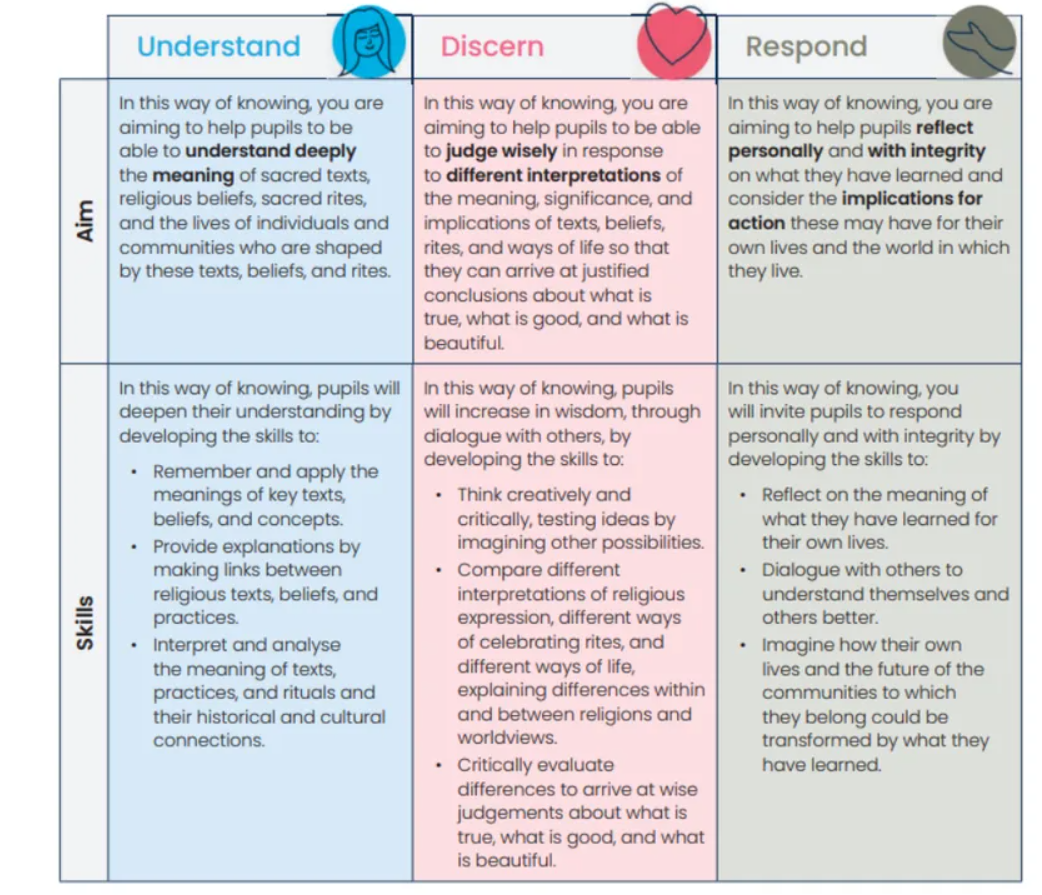
- Understand (head): knowing and remembering Scripture, doctrine and Church teaching
- Discern (heart): thinking critically, reflecting and making learning personal
- Respond (hands): expressing their own thinking and faith, and putting learning into practiceeaching and Learning
Scripture, Church teaching and the liturgical year are at the centre of every unit. Children learn through discussion, drama and role play, art, music and poetry, extended writing, and times of reflection and stillness. RE also links with our RSHE and PSHE teaching.
Each unit has a Knowledge Organiser, kept in children's RE books, showing the key objectives and expected outcomes. RE homework often involves families, for example talking about a Scripture passage or praying together.
Teaching and Learning
Scripture, Church teaching and the liturgical year are at the centre of every unit. Children learn through discussion, drama and role play, art, music and poetry, extended writing, and times of reflection and stillness. RE also links with our RSHE and PSHE teaching.
Each unit has a Knowledge Organiser, kept in children's RE books, showing the key objectives and expected outcomes. RE homework often involves families, for example talking about a Scripture passage or praying together.
Assessment and Reporting
We assess what children know, understand and can do in RE. We never assess a child's faith or religious practice.
- Children are assessed against the expected outcomes on each Magister Knowledge Organiser.
- Progress is tracked every half-term, with extra support where it is needed.
- After every branch, staff moderate work with other local Catholic primary schools, and we take part in the Diocese of Lancaster's annual moderation.
- Progress is shared with parents in the annual report and at parents' evenings, as for English and maths.
- RE is monitored at least twice a year through lesson observations, work scrutiny and planning review.
- RE, Catholic Life and Mission, and Prayer and Liturgy are inspected by the Catholic Schools Inspectorate.
Inclusion
Every child, including those with SEND and the most able, is entitled to a rich and ambitious RE curriculum. Teachers adapt lessons so every child can succeed, planning support with the SENDCo where needed. Teaching and resources are chosen with sensitivity to each child's cultural, social and family background.
Children who are not Catholic take a full part in RE and, as far as possible, in the religious life of the school. Only Catholic children receive the Sacraments, and no child is ever asked to profess a faith they do not hold.
Other Faiths and Worldviews
Through the Dialogue and Encounter branch, children learn to understand and respect people of different faiths and none. They study other Christian traditions and Christian unity, Judaism and Islam, and in Year 6 the Dharmic religions: Hinduism, Sikhism, Buddhism and Jainism. See our [Other Faiths] page for more.
RE Beyond the Classroom
Prayer, collective worship and reflection are part of every school day. We work closely with Our Parish to prepare liturgies and celebrations through the The Liturgical Year
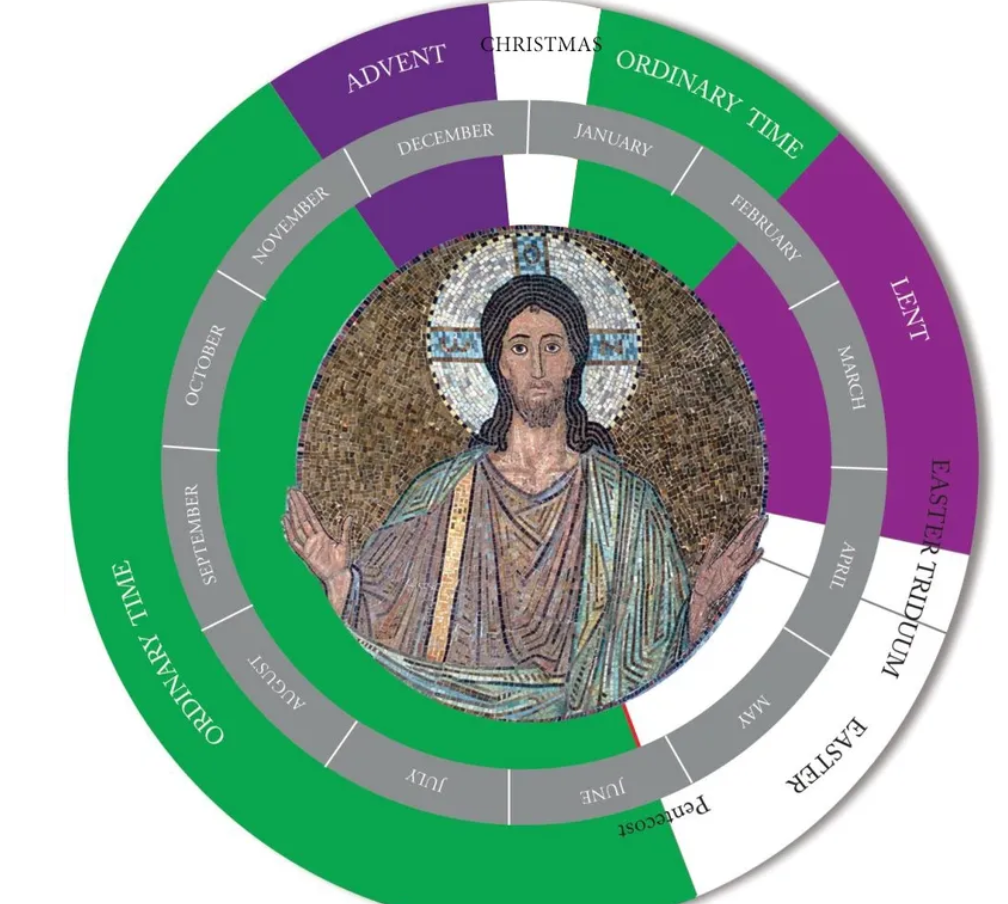
The Liturgical Year, also known as the Church Year or Calendar, is a cycle that governs the observance of various Church Seasons, holy days, feast days (including celebrations of Saints), and the reading of Scripture. These readings are organised either in an annual cycle or over several years, covering the Gospel and other readings during Mass.
In addition to guiding the Scripture readings, the Liturgical Calendar also influences the interior decoration of the Church, the colours of the Priest’s vestments (which change according to the Season), and the timing of key spiritual practices like Lent. It shapes the rhythm of the Church year and the flow of liturgical life.
The Liturgical Year is divided into seven main seasons, with the most solemn being the Sacred Paschal Triduum, the three-day period leading up to Easter. The Church Year begins with Advent, typically in November or December, and concludes the following year with the Feast of Christ the King, also in November or December.
and we value the partnership between home, school and parish in each child's faith journey. Families can join in at home with Wednesday Word and Family Prayer Time and CAFOD's resources for families and a variety of links and activities that are shaped on Classdojo throughout the year.
Right to Withdraw
Parents and carers have the right to withdraw their child from RE. If you are thinking about this, please contact the school office to arrange a conversation with the Headteacher first.
Key Vocabulary
These are the three key concepts for each branch. The full vocabulary lists are in the RE Policy.
|
Year |
Creation and Covenant |
Prophecy and Promise |
Galilee to Jerusalem |
Desert to Garden |
To the Ends of the Earth |
Dialogue and Encounter |
|---|---|---|---|---|---|---|
|
Reception |
Love, Father, Holy Spirit |
Mary, Nativity, Love |
Glory Be, Magi, Celebrate |
Lent, Easter, Holy Week |
Holy Spirit, Pentecost, Church |
Community, Faith, Jesus |
|
Year 1 |
Creation, Father, Creed |
Annunciation, Hail Mary, Jesus |
Son of God, Mission, Light |
Lent, Crucifixion, Resurrection |
Holy Spirit, Pentecost, Ascension |
Church, Parish, Judaism |
|
Year 2 |
Covenant, Baptism, Sin |
Advent, Prophet, Annunciation |
Miracle, Parable, Forgiveness |
Forgiveness, Reconciliation, Sin |
Holy Spirit, Pentecost, Prayer |
Neighbour, Hebrew, Respect |
|
Year 3 |
Creator, Dignity, Genesis |
Advent, Joseph, Mass |
Parable, Miracle, Kingdom of God |
Last Supper, Eucharist, Mass |
Holy Spirit, Pentecost, Discipleship |
Exodus, Islam, Passover |
|
Year 4 |
Covenant, Faith, Forgiveness |
Advent, Prophet, John the Baptist |
Messiah, Incarnation, Anointing of the Sick |
Lent, Forgiveness, Sin |
Church, Apostles, Creed |
Islam, Christian, Common Good |
|
Year 5 |
Covenant, Exodus, Commandments |
Psalm, David, Advent |
Beatitude, Our Father, Transfiguration |
Lent, Sin, Prayer |
Holy Spirit, Confirmation, Discipleship |
Bible, Old Testament, Hebrew |
|
Year 6 |
Creation, Fall, Baptism |
Mary, Old Testament, Salvation History |
Sacraments, Cana, Lazarus |
Holy Week, Crucifixion, Stations of the Cross |
Resurrection, Witness, Saint |
Common Good, Unity, Dialogue |
Documents
- RE Curriculum Overview: Reception
- RE Curriculum Overview: Years 1 and 2 (Cycle A and Cycle B)
- RE Curriculum Overview: Years 3 and 4 (Cycle A and Cycle B)
- RE Curriculum Overview: Years 5 and 6 (Cycle A and Cycle B)
- RED SEND Guidance
- Right to Withdraw from RE: Information for Parents
- Religious Education Policy 2026–27
- Prayer and Liturgy Policy 2026–27
- To Know You More Clearly: the Religious Education Directory (Bishops' Conference of England and Wales)
- Diocese of Lancaster
Contact
If you have any questions about RE, please contact Miss Savage, Headteacher and RE Subject Leader, through the school office.