Prayer and Liturgy
We care, we belong, we learn together in faith
At St Joseph's, prayer is not simply something we do together at set times of the day — it is a relationship with God that we are helping every child to discover, and to carry with them for life.
“May I know you more clearly, love you more dearly, and follow you more nearly, day by day.”
Prayer of St Richard of Chichester
This prayer sits at the heart of our school vision:
In the faithful care of St Joseph, Jesus prospered.
We care, we belong, we learn together in faith.
Everything we do in prayer and liturgy flows from this — helping every child to know Christ more clearly, love him more dearly, and follow him more nearly, day by day.
This page sets out how prayer and liturgy are woven through daily life at St Joseph's, following our Prayer and Liturgy Policy (2026-27), which is itself rooted in the Bishops' Conference guidance To Love You More Dearly, the Church's directory for prayer and liturgy in Catholic schools.
What We Believe About Prayer
Prayer, first and foremost, is an encounter with the living Christ. Through scripture, silence, symbol, music, sacrament and community, every child is invited to know that God speaks to them, walks beside them, and calls them to live as his disciples.
We hold to a simple but important principle: prayer and liturgy are formative before they are performative. Their purpose is to deepen each child's relationship with Christ and nurture a lifelong habit of faith — not simply to deliver a well-presented assembly. With that in mind, our prayer and liturgy is always:
- Inclusive, formative and transformative for every child.
- An opportunity for every pupil to experience, take part in, and lead prayer.
- Shaped by the rhythm of the Church's year — its seasons, feasts and celebrations.
- Age-appropriate, engaging and accessible to all, whatever their starting point.
A Day at St Joseph's — Our Daily Rhythm of Prayer
Prayer is woven into the rhythm of every school day. Three moments anchor each day for every class:
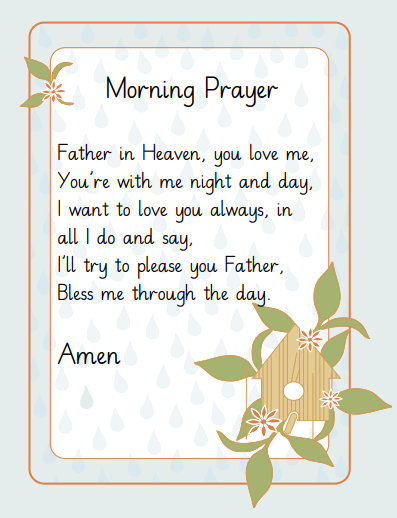
- Morning Prayer — praising God for the new day and his creation, and looking ahead with trust in his guidance.
- Grace Before Meals — giving thanks for the food we are given, and remembering those who go without.
- End of Day Prayer — giving thanks for the day, reflecting on it together, and placing our worries in God's hands.
Our school prayers

All staff model reverence and take part alongside the children, so that prayer becomes a natural, unforced part of school life rather than something simply delivered to pupils.
Our Weekly Pattern
Alongside daily prayer, each class takes part in a weekly Celebration of the Word, supported by our Ten Ten prayer and liturgy resources and adapted to suit our own school community:
|
Day |
What Happens |
Led By |
|
Monday |
Whole-school Celebration of the Word (Hall) |
Headteacher |
|
Tuesday |
Class Christian meditation |
Staff |
|
Wednesday |
Whole-school Celebration of the Word, including hymns (Hall) |
Father Paul / staff |
|
Thursday |
Class Celebration of the Word (Child led) |
Staff and children |
|
Friday |
Whole-school celebration assembly, with parents joining once a month |
Headteacher |
Children in Class 2 are supported to plan and lead their own class liturgy once a week — one small, practical example of how leadership in prayer grows throughout a child's time with us.
Our Pattern of Prayer: Welcome, Word, Worship, Witness
Every act of prayer and liturgy at St Joseph's follows a simple, consistent shape, so that children come to recognise it wherever they meet it — in class, in the hall, or at Mass:
Welcome
We think carefully about how we gather together — the environment we create and the focal point we gather around.
Word
Sacred Scripture lies at the heart of every celebration. We believe that when the Scriptures are proclaimed, Christ himself speaks to his people — so children learn not simply to hear the Gospel, but to listen deeply, reflect prayerfully, and respond.
Worship
We respond to God's word together, offering a prayer that relates directly to what we have just heard.
Witness / Go Forth
Every child takes something away from their prayer that they can act on in their own life, or share with somebody else.
Sacred Spaces
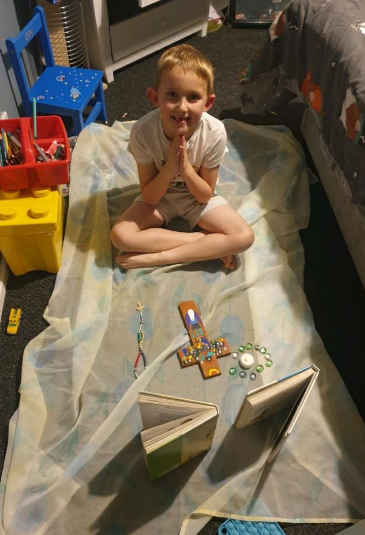
Every classroom has its own prayer table, reflecting the colour and mood of the Church's current season, along with scripture, symbols and images that change throughout the year. Alongside these, our central prayer space offers a quiet place for individual and small-group prayer.
These spaces are never simply decorative. They invite children into wonder, reverence and stillness, and act as a visible, everyday reminder that Christ is present within our school community.
The Spirituality of St Joseph
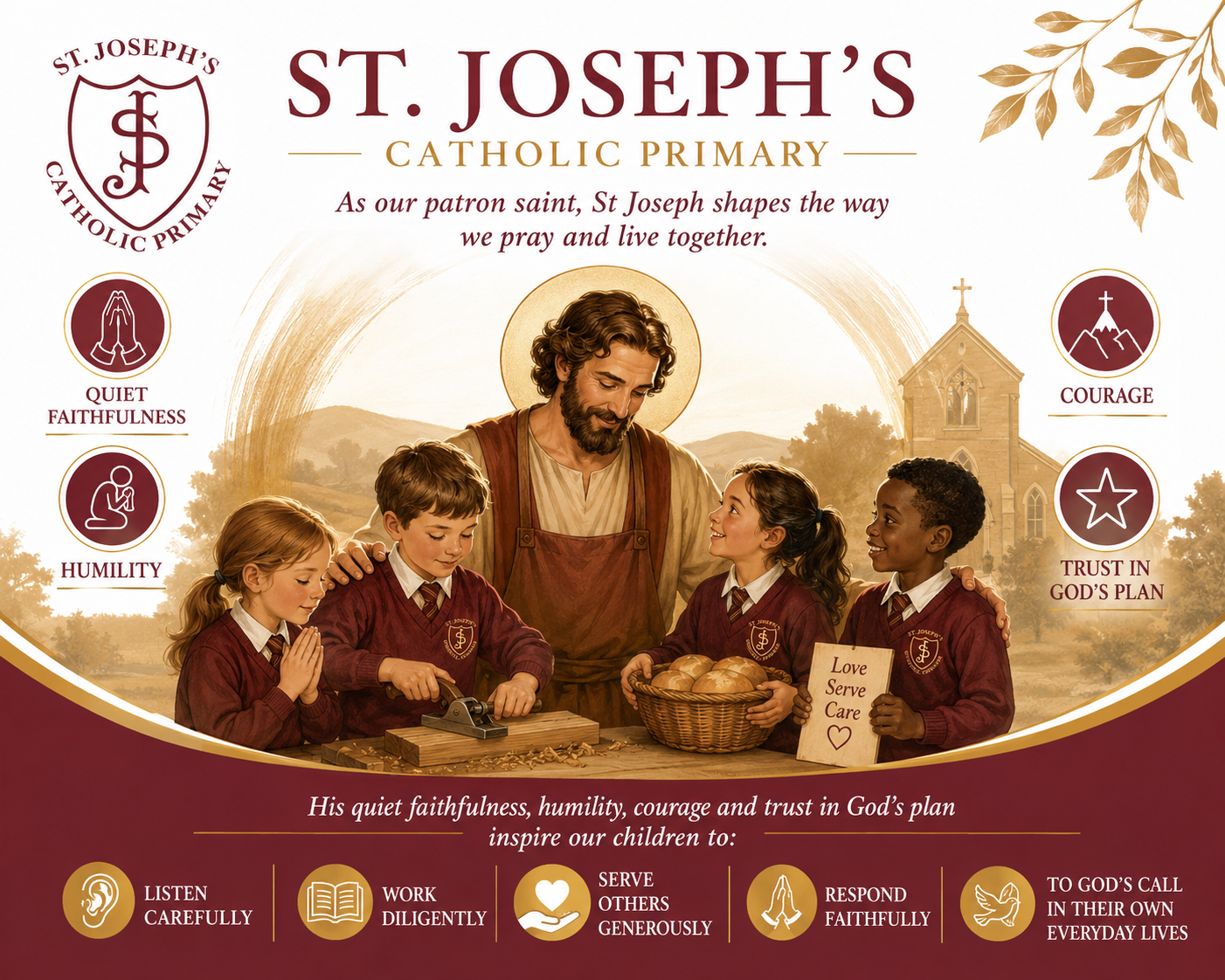
As our patron saint, St Joseph shapes the way we pray and live together. His quiet faithfulness, humility, courage and trust in God's plan inspire our children to listen carefully, work diligently, serve others generously, and respond faithfully to God's call in their own everyday lives.
Listening to God: Lectio Divina, Visio Divina and Christian meditation
At St Joseph's, we believe that prayer is about listening to God, not only speaking to him. Throughout the year, children experience three contemplative forms of prayer, carefully adapted to their age and stage:
- Lectio Divina — praying with Sacred Scripture, following a simple rhythm: Read, Reflect, Pray, Rest.
- Visio Divina — praying with sacred images, following a rhythm of Look, Notice, Wonder, Listen, Respond.
- Christian Meditation — sitting quietly and still, often returning gently to a single simple prayer word, to rest in God's presence beyond words.
Christian Meditation
Christian Meditation gives children a regular, unhurried space simply to be still with God. Sitting quietly, with a straight back and stillness in body and mind, children return gently to a short prayer word — such as Maranatha, come Lord Jesus — whenever their thoughts wander, letting go of distraction and resting in God's presence.
This simple discipline of silence complements our more active, spoken forms of prayer. Over time, children build a genuine capacity for stillness, learning that some of the deepest moments of prayer happen not in words, but in quiet, attentive rest in God's company.
As children move through the school, they grow more confident in leading these forms of prayer for themselves — choosing scripture or images, introducing a period of meditation, asking thoughtful questions, and helping others to reflect more deeply.
Special Times: Masses, Feast Days and the Liturgical Year
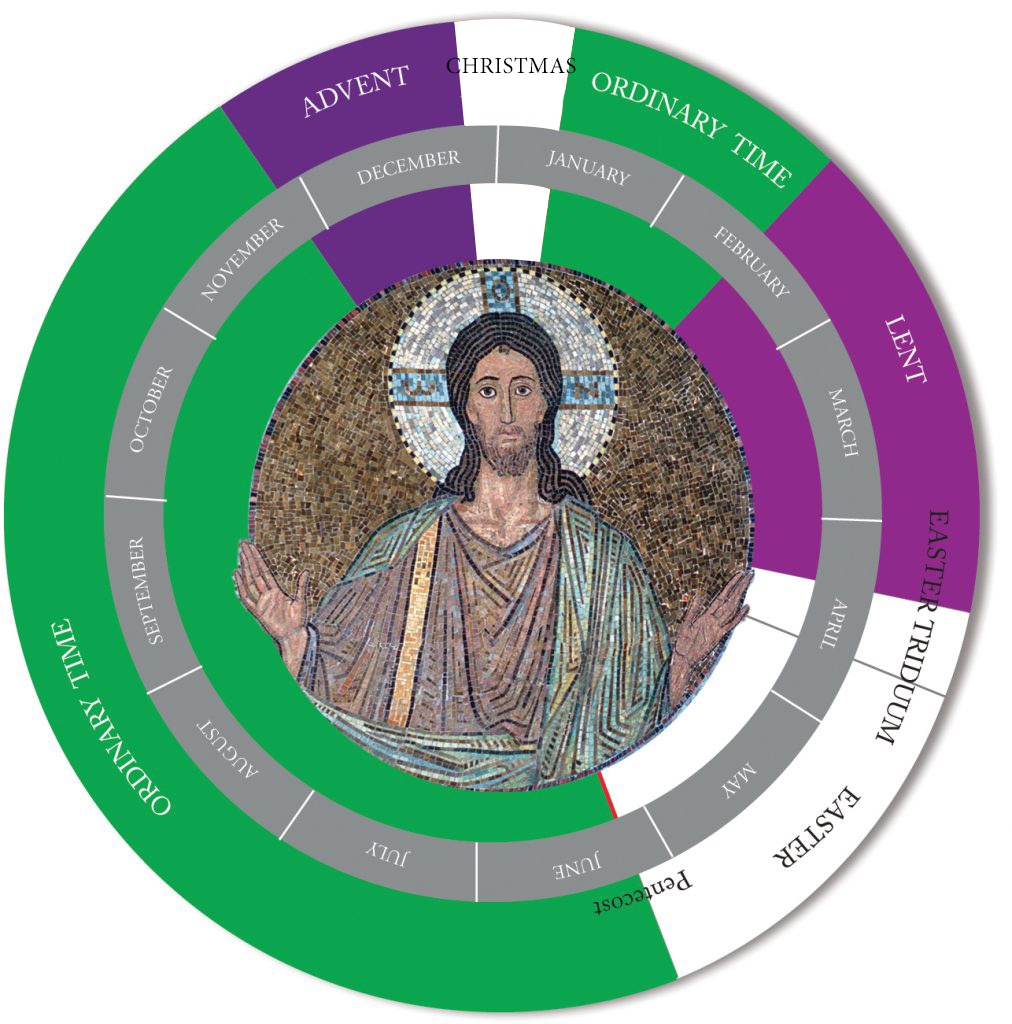
Our calendar of prayer and liturgy follows the rhythm of the Church's year. Every year, our Annual Provision of Prayer and Liturgy is reviewed and updated, so that it stays current, reflects the life of our school and parish, and continues to give every child a rich experience of the Church's liturgical seasons and feasts.
[Link: Annual Provision of Prayer and Liturgy 2026-27]
You can also read our full Prayer and Liturgy Policy here: [Link: Prayer and Liturgy Policy 2026-27]
Highlights from this year's calendar include:
Autumn
- Season of Creation Mass and assembly, and Laudato Si' ambassadors
- Month of the Rosary, including a human rosary made by Key Stage 2
- All Saints' Day Mass and Foodbank assembly and collection
- Advent wreath and our Santa Dash in aid of Mary's Meals
- Class 1 Nativity, Carol Service in church for family and parish, and Reconciliation for Class 2
Spring
- Epiphany Mass and Candlemas, marking the Month of the Holy Family
- Ash Wednesday Mass, Lenten promises and reconciliation, and our Big Lent Walk
- Stations of the Cross and a pilgrimage to St Mary's and the Grotto
- St Joseph's Day — Mass, card-making and a coffee morning for parents and parishioners
- Easter cards and daffodils for parishioners, and the Great Cumbrian Litter Pick
Summer
- St Joseph the Worker Day and the Month of Mary, with hymn practice dedicated to her
- Ascension and Pentecost, marked as Holy Days of Obligation
- First Holy Communion (bi-annual) and Class Masses
- Year 6 Leavers' Mass, marking the end of their journey with us
Throughout the year, our headteacher leads a weekly Gospel assembly, the Pope's monthly prayer intention is shared with the whole school, and Father Paul leads weekly hymn practice alongside a member of staff.
Masses and the Eucharist
Whole-school Masses mark the major feasts of the Church's year, the opening and closing of terms, and our own patronal celebrations. These are genuine partnerships between school, parents and parish — everyone is welcome to join us.
Pupils take an active part, as readers, psalmists, servers, gift bearers and welcomers. Preparation always includes time with the scripture itself, hymn practice, rehearsal, and quiet formation in what it means to serve reverently.
Pupils Growing as Disciples
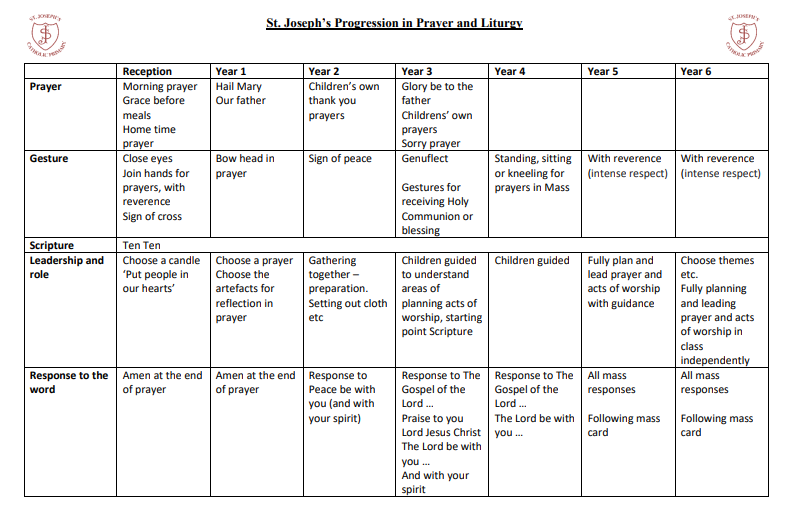
Leadership in prayer develops progressively throughout a child's time at St Joseph's, so that children grow in confidence as disciples of Christ — not simply as presenters standing at the front. The emphasis, always, is on authentic prayer and a genuine encounter with Christ.
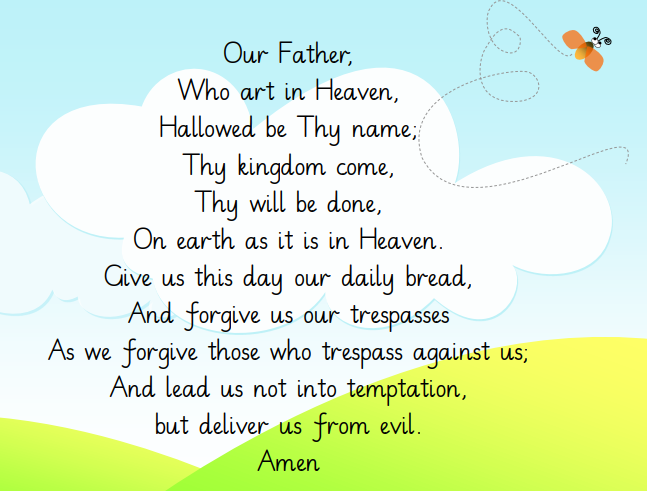
- Reception and Key Stage One — children learn traditional prayers such as the Sign of the Cross, the Lord's Prayer and Grace Before Meals, and begin to take simple roles such as choosing a candle or a prayer.
- Lower Key Stage Two — children help gather materials, choose readings, and take part in preparing a class Celebration of the Word.
- Upper Key Stage Two — children plan and lead their own liturgies, choose appropriate scripture, and take on Mass roles such as reader, gift bearer or welcomer.
In practice · Children in Class 2 already plan and deliver their own class liturgy once a week, and our older pupils regularly take on reader, server and welcomer roles at whole-school Mass.
Pupil and Parent Voice
Nothing tells the story of prayer and liturgy at St Joseph's better than the words of our own children and families.
What our pupils say
[Placeholder: add 2-3 genuine pupil quotes here — for example, reflections on leading a class liturgy, taking part in Mass, or a favourite moment of prayer during the school day.]
What our parents say
[Placeholder: add 1-2 genuine parent quotes here — for example, reflections on shared family liturgies, sacramental preparation, or how prayer at school has shaped home life.]
Our Parish Family
We maintain strong, living links with our parish, St Mary and St Joseph's, and with the Diocese of Lancaster. Father Paul is a regular and valued visitor to our school, leading Mass, hymn practice, and taking a close interest in the spiritual life of our children.
We recognise parents as the first educators in faith. Through shared liturgies, sacramental preparation, family prayer resources and parish celebrations, we work to build a genuine partnership between home, school and parish, so that children experience a consistent life of faith wherever they are.
Welcoming Everyone
Prayer and liturgy are central to our Catholic identity, and open to all. We welcome pupils and families of every faith, and none, to take part respectfully, and we make reasonable adjustments for children with SEND, EAL or other additional needs, using visual prompts, symbol-supported texts and multi-sensory approaches where they are helpful.
We recognise that every child is on their own faith journey, and we aim to ensure that all pupils are welcomed and respected in their participation, able to access prayer and liturgy at their own level of understanding, and encouraged — never required — to take part.
Parents have a legal right to withdraw their child from acts of prayer and liturgy up to the age of 16 (School Standards and Framework Act 1998, s.71(1A)); any parent wishing to discuss this is welcome to speak to the headteacher.
Keeping Children Safe
All adults follow our safeguarding procedures at all times. Where a child shares something personal or sensitive during prayer, staff respond with pastoral care and confidentiality, and escalate any concerns in line with our safeguarding policy. Risk assessments are completed for any liturgy taking place off-site, such as visits to church.
Checking How We're Doing
The quality and impact of prayer and liturgy across our school is monitored and evaluated regularly, and at least once a year, involving pupils, parents, staff, clergy and governors. What we learn feeds directly back into how we plan prayer and liturgy for the year ahead.
Prayers We Treasure
Children at St Joseph's grow up knowing a shared treasury of prayer, learned and returned to again and again throughout their time with us. A few of our best-loved prayers:
The Sign of the Cross
In the name of the Father, and of the Son, and of the Holy Spirit. Amen.
Grace Before Meals
Bless us, O Lord, and these your gifts, which we are about to receive from your bounty.
Through Christ our Lord. Amen.
Prayer of St Richard of Chichester
Thanks be to you, my Lord Jesus Christ, for all the benefits which you have given me,
for all the pains and insults which you have borne for me.
O most merciful Redeemer, friend and brother, may I know you more clearly, love you more dearly,
and follow you more nearly, day by day. Amen.
A Prayer to St Joseph
Dear St Joseph, you were a kind and gentle father to Jesus, and a loving guardian of the Holy Family.
Help us to work hard too — in our learning, in our play, and in the way we treat others.
Watch over us each day and guide us to make good choices.
St Joseph, pray for us. Amen.
Living Prayer Beyond School
Our hope is that prayer does not end when the school day finishes. We encourage children and families to keep praying together at home, to take part in parish life, and to recognise God's presence in family life, in creation, and in service of others.
Through prayer and liturgy, we seek to nurture children who grow into lifelong disciples of Jesus Christ — the true measure of everything on this page.
This page reflects our Prayer and Liturgy Policy, approved by governors in February 2026 and due for review in July 2026.
Our prayer room
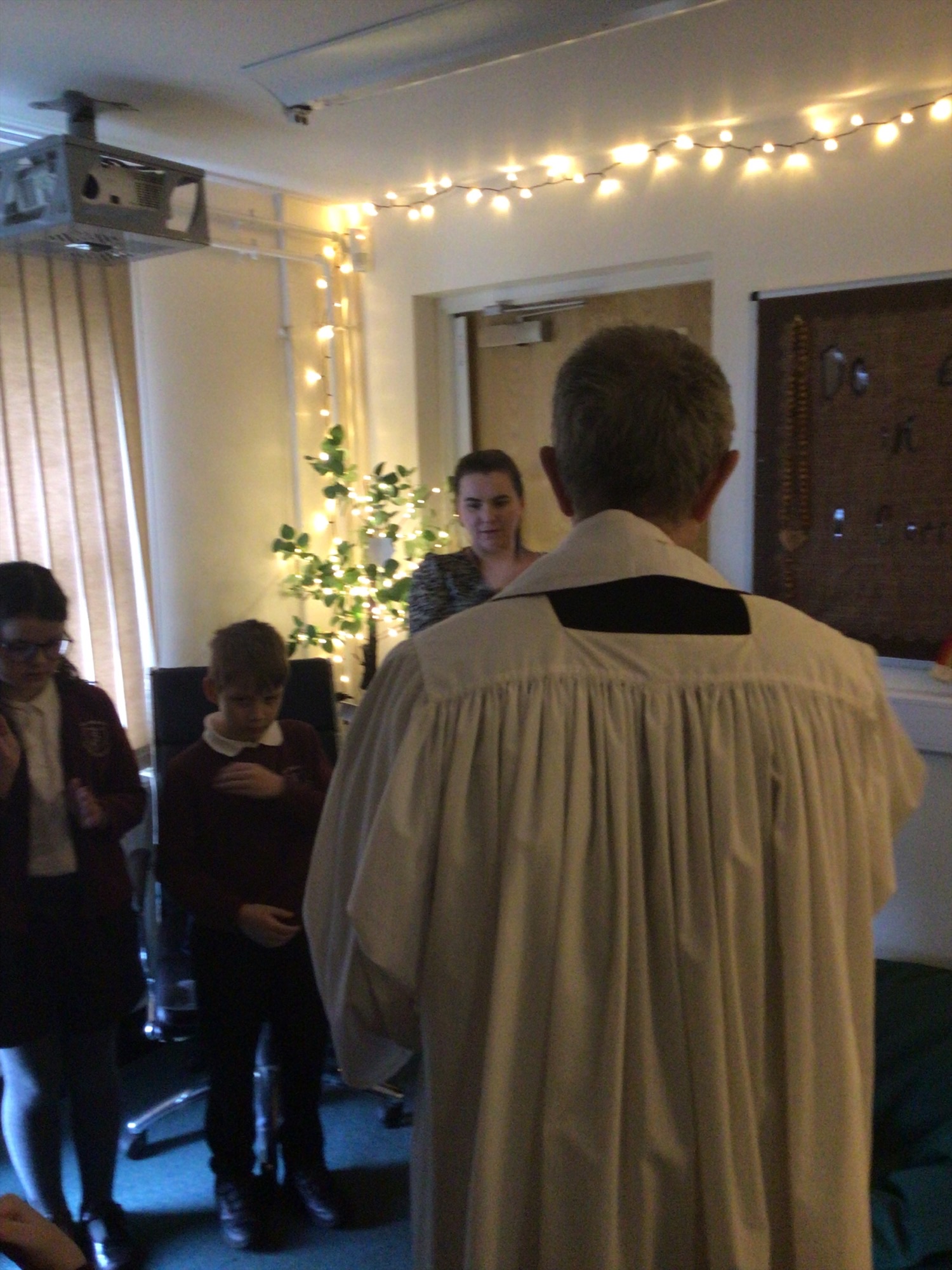
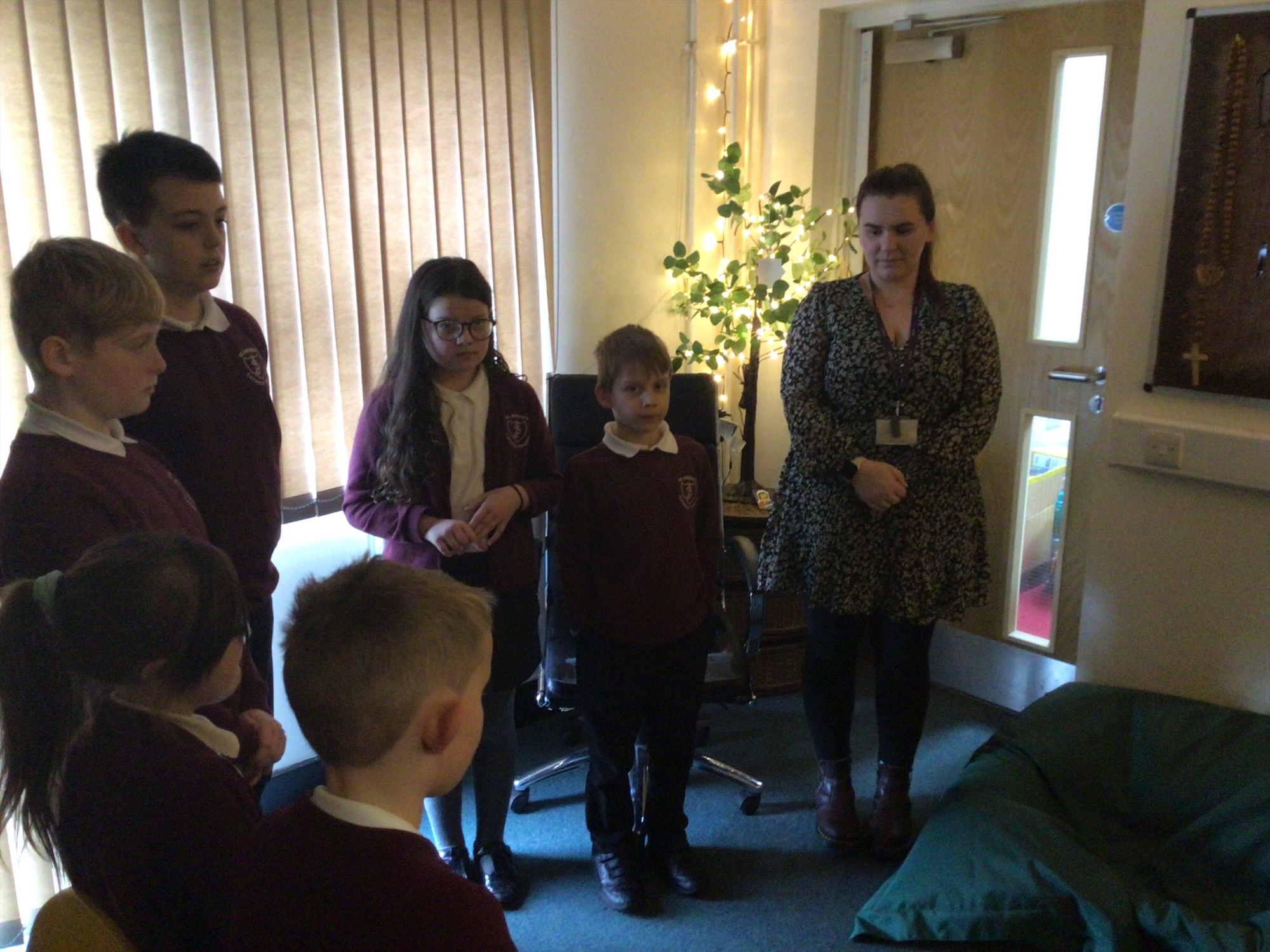
Father Paul came to bless our school prayer room.
At home
Pope's prayer intention
Policy